



CES® 2026 offered a glimpse into how beauty routines are quietly evolving, and L’Oréal Groupe was at the center of that shift. This year, the company introduced two light powered technologies that move beyond novelty and into everyday relevance: Light Straight + Multi styler for hair and LED Face Mask for skincare. Both innovations were named CES® 2026 Innovation Award honorees, highlighting L’Oréal’s focus on practical, science driven solutions that fit naturally into how people care for themselves.
For L’Oréal, this moment builds on a long standing belief that beauty and science evolve together. For more than 115 years, the company has paired scientific discovery with creativity to make beauty more effective, more personal, and more grounded in real needs. The technologies introduced at CES 2026 reflect that mindset, focusing less on futuristic spectacle and more on how innovation can quietly improve everyday routines, now and in the years ahead.
Light Straight + Multi styler brings precision and protection to hairstyling
Hair straighteners have been around for over a century, but the basic tradeoff has hardly changed. High heat delivers results, but often at the expense of hair health. Many traditional styling tools reach temperatures of 400 degrees Fahrenheit or more, well beyond the point where keratin begins to break down. Over time, that damage shows up as weakened cuticles, breakage, and dullness. Consumers are increasingly aware of this cost. In a 2024 U.S. consumer study conducted by L’Oréal, 58 percent of women surveyed said their hair damage was caused by heat.
Light Straight + Multi styler was developed by L’Oréal Research and Innovation to directly address that tension between performance and protection. Instead of relying solely on extreme surface heat, the device uses patented infrared light technology to style hair at lower temperatures while maintaining professional level results. Its advanced glass plates never exceed 320 degrees Fahrenheit, a significant reduction compared to most traditional straighteners. According to instrumental testing conducted by L’Oréal, the device styles hair three times faster and leaves it twice as smooth as leading premium hair tools.
What makes this approach different is where the technology does its work. Light Straight + Multi styler uses near infrared light, a wavelength just beyond what the eye can see, that penetrates deeply into the hair fiber. This light reshapes internal hydrogen bonds, the molecular structures responsible for hair’s natural shape and texture. By working from the inside out, the tool minimizes surface damage and helps keep the cuticle smoother, shinier, and stronger over time.
The result is a styling experience that feels familiar but behaves very differently. Rather than correcting damage after it happens, Light Straight + Multi styler is designed to limit cumulative heat exposure from the start. That shift moves hairstyling toward prevention, helping protect hair not just for today’s look, but for long term health as well.
Beyond straightening, the device is built for versatility. It can smooth, shape, and curl with precision, reducing the need for multiple tools. Smart internal sensors, paired with proprietary algorithms and machine learning, adapt to the user’s gestures in real time, fine tuning performance to create a more personalized and intuitive experience.
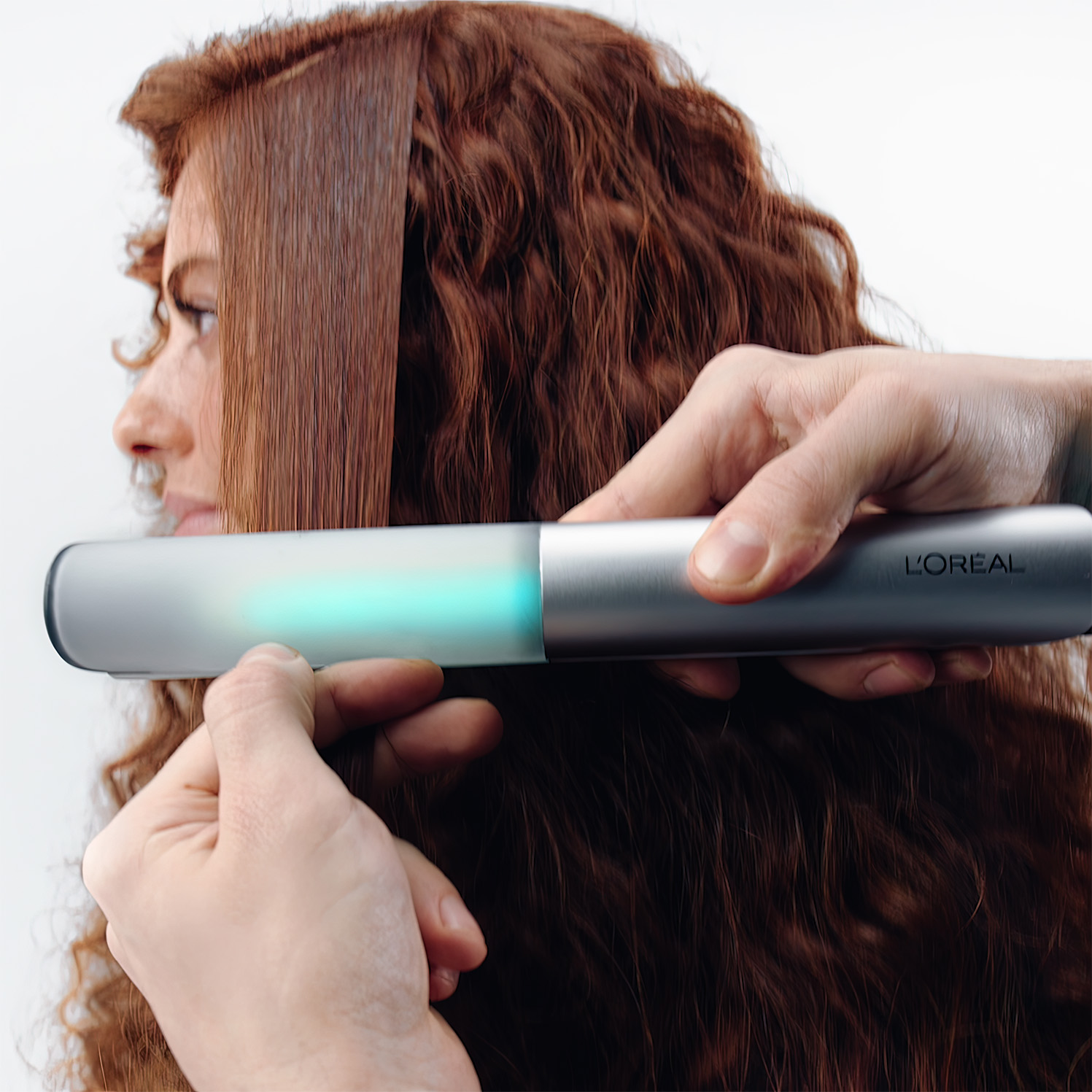
With this launch, L’Oréal now offers a more complete light powered styling ecosystem, building on innovations like AirLight Pro, first unveiled at CES 2024. Together, these tools point toward a future where styling performance and hair health are no longer competing priorities.
Light Straight + Multi styler is expected to launch globally in 2027, with additional details, including pricing, to be shared closer to release. The infrared technology is protected by a granted French patent, with a U.S. patent currently pending.
LED Face Mask explores the next chapter of at home skincare
L’Oréal’s focus on light technology does not stop at hair. At CES® 2026, the company also introduced LED Face Mask, another Innovation Award honoree that reflects growing interest in longevity science and device led skincare.
Currently in prototype form, the ultra thin, flexible silicone mask is designed to deliver light evenly across the face in a way that fits naturally into daily routines. Developed in collaboration with iSmart, a global leader in LED device innovation, the mask targets visible signs of aging such as fine lines, loss of firmness, and uneven tone using carefully selected wavelengths of light.
The design is intentionally low friction. The mask is lightweight, non invasive, and flexible enough to contour comfortably to the face. Each session is automatically timed to ten minutes, making it easy to integrate into an existing skincare routine without adding complexity or guesswork.
At the core of the device is an advanced transparent support layer embedded with a skin safe microcircuit. This system precisely controls the emission of two wavelengths: red light at 630 nanometers and near infrared light at 830 nanometers. These wavelengths are widely studied for their ability to support visible firmness, smoothness, and more even looking skin tone, delivering benefits without heat or discomfort.
LED Face Mask is expected to launch in 2027. Together with Light Straight + Multi styler, it reflects a broader shift in beauty technology toward smarter, gentler, and more intentional tools. Rather than chasing novelty for its own sake, L’Oréal’s latest innovations focus on making advanced technology feel practical, personal, and genuinely useful in everyday life.