



Dell Technologies is turning the spotlight back to consumers and gamers with a sweeping refresh across laptops, gaming rigs, and pro displays. The company is reestablishing XPS as a design forward, performance focused flagship with the all new XPS 14 and XPS 16, previewing a return of XPS 13 later in the year at the most accessible XPS price to date. Alienware is set to broaden its reach by doubling the size of its notebook lineup and debuting anti glare OLED panels. On the desktop and mobile side it is moving to the latest Intel Core Ultra 200HX processors and to AMD second generation Ryzen 9000X3D for its flagship tower. For creators and power users, Dell UltraSharp is introducing two monitors that lean into firsts, including what it calls the world’s first 52 inch 6K display.
Here is the short version of why this matters. XPS is back as a lighter and thinner platform that still promises serious performance and battery life. Alienware is designing for more types of gamers and more budgets while tackling OLED glare and reflections head on. UltraSharp is pushing screen real estate and panel innovation in ways that simplify complex workflows. Across the board the updates aim to make premium technology feel more approachable in everyday use.
Jeff Clarke, vice chairman and chief operating officer at Dell Technologies, frames the push as a return to roots with a tighter focus on consumer and gaming. He emphasizes a complete XPS redesign built around exceptional craftsmanship in the thinnest and lightest form factors yet and confirms that XPS 13 will come back as the most accessible XPS ever. He also notes that Alienware will effectively double its notebook portfolio so the company can meet more customers at more price points.
XPS returns with a clean, streamlined industrial direction
The new look is simple and intentional. For the first time the XPS logo sits on the lid, a clear signal of the brand’s reset. XPS 14 and XPS 16 are carved from CNC machined aluminum, pair refined I O with vivid displays, and are tuned for sustained performance. Dell claims industry leading endurance with up to 27 hours of Netflix streaming and more than 40 hours of local video playback under defined test conditions.
Portability is a headline feature. These are Dell’s thinnest laptops at 14.6 millimeters. XPS 14 weighs roughly three pounds, over half a pound lighter than the prior generation. XPS 16 is around 3.6 pounds, nearly a full pound lighter than its predecessor. Both models offer tandem OLED options and run on Intel Core Ultra Series 3 with built in Intel Arc graphics featuring 12 Xe cores. In practice that combination targets fast everyday work, rich media, and on the go creative tasks without dragging extra weight.
The roadmap extends beyond these two systems. Later in the year Dell plans to expand the XPS family with additional form factors and price points. That includes the return of XPS 13, expected to be the thinnest and lightest XPS yet and positioned at the most accessible price in XPS history.
Performance, thermals, and real world speed
Intel Core Ultra Series 3 with integrated Arc graphics is central to the pitch. Dell cites up to 57 percent and 78 percent faster AI performance for XPS 14 and XPS 16 respectively and more than 50 percent faster graphics versus previous models. These chips also power Copilot Plus PC experiences and are meant to accelerate image editing, smooth video playback, and responsive gaming.
Keeping that performance steady requires better cooling, so Dell reworked the thermal system. The new design uses the company’s largest and thinnest fans to date to improve airflow and sustain higher performance while staying cooler and quieter. Dell credits these decisions with enabling the thin profiles and longer runtimes.
Mobility focused engineering shows up in the details. The camera system integrates what Dell calls the thinnest and narrowest eight megapixel 4K module ever in a Dell laptop. New 900ED energy density battery cells are smaller and lighter yet deliver more power. The combination helps push bezels tighter and keeps the design thin without sacrificing capability. Dell notes that XPS 14 has a smaller footprint than MacBook Air 13 while still offering more screen area.
Alienware widens the tent for PC gaming
Alienware is making room for more kinds of players. Later this year the brand plans two new notebook classes. One is an ultra slim gaming laptop at roughly seventeen millimeters that pairs serious performance with easy mobility. The other is a true entry level model that brings Alienware styling and features to a broader audience at lower price points. The goal is simple coverage from dedicated enthusiasts to casual gamers to users who split time between gaming and productivity.
Display quality is a standout. Alienware is introducing anti glare OLED panels on the Alienware 16 Area 51 and Alienware 16X Aurora. The idea is to keep the deep blacks, saturated colors, and high contrast of OLED while addressing glare and reflection, a common pain point for bright rooms. These two laptops, along with the Alienware 18 Area 51, move to Intel Core Ultra 200HX processors. For desktops, the Alienware Area 51 tower adopts AMD Ryzen 9850X3D with 3D V Cache for higher end frame rates and compute heavy workloads.
The OLED story dives into specifics. Across the class leading 16 inch family, the new panels reduce gloss by 32 percent to cut reflections and minimize fingerprint smudges. They are rated at zero point two millisecond response time, which is fifteen times faster than earlier three millisecond LCD tech, and support HDR True Black 500, peak HDR brightness of 620 nits, and a claimed 120 percent DCI P3 color volume. VESA HDR ClearMR 9000 aims to eliminate ghosting in high speed scenes. An anti glare coating diffuses reflections without dulling color. Built in AI helps manage pixel refresh for panel health. Chassis durability targets include 15 kilogram lid pressure testing and a 20,000 cycle hinge lifespan. Rounding out performance, the Alienware 16X Aurora, Alienware 16 Area 51, and Alienware 18 Area 51 pair the new Intel silicon with NVIDIA GeForce RTX 50 Series GPUs.
UltraSharp pushes displays forward for work and creation
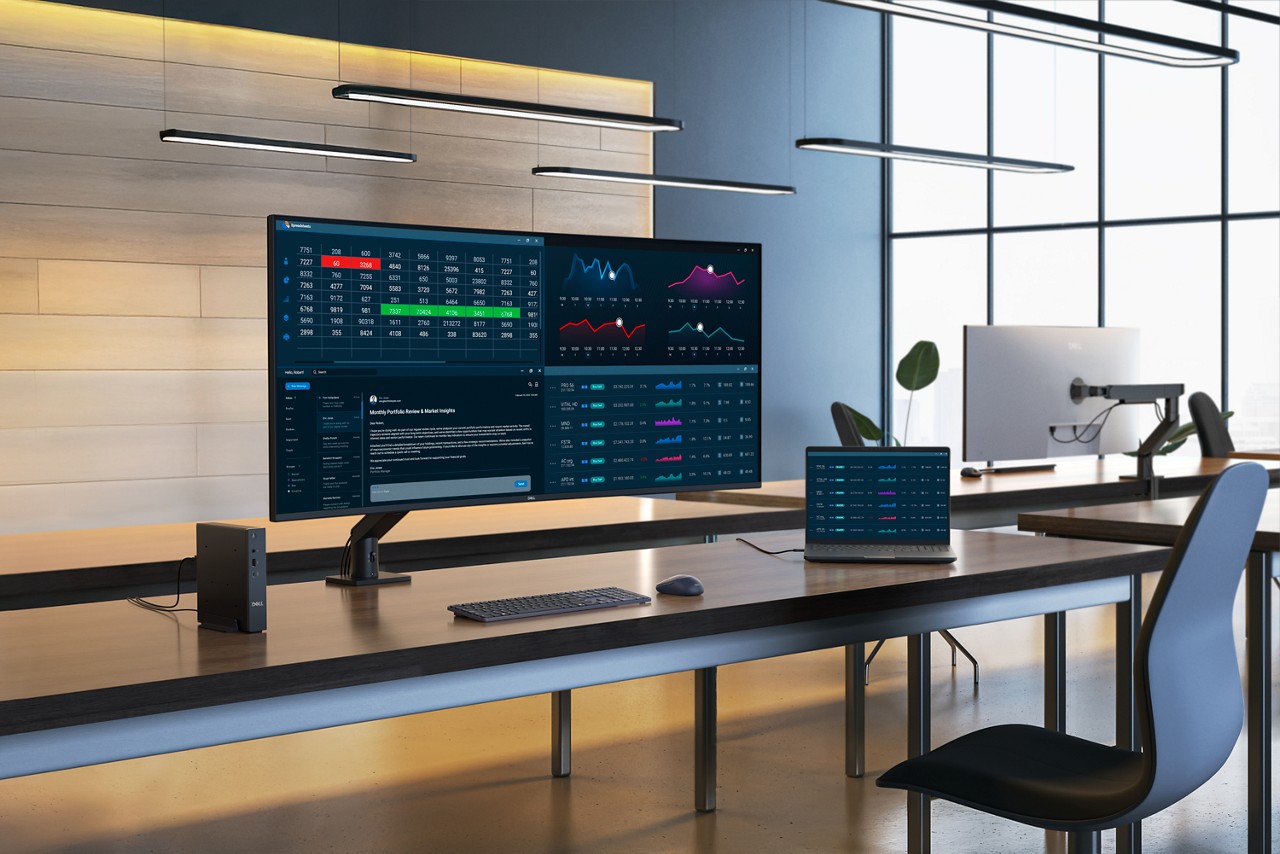
For power users who live in windows and timelines, Dell introduces two headline monitors. The Dell UltraSharp 52 Thunderbolt Hub Monitor is positioned as the world’s first 52 inch 6K monitor and the first display to reach the highest tier of TÜV Rheinland Low Blue Light certification. It targets financial traders, data scientists, engineers, and executives who want a single expansive canvas instead of multiple screens. The panel delivers 6K resolution at 129 pixels per inch, a 120 hertz refresh rate, and IPS Black for deeper blacks and sharper detail. Dell says it emits up to 60 percent less blue light than competing models while maintaining pro grade color. An ambient light sensor adjusts for comfort during long sessions.
Connectivity and control are designed for complex desks. Users can connect up to four personal computers at once. An internal multi stream transport system works with picture by picture so each partition functions like an independent monitor. Built in KVM lets one keyboard and one mouse control all connected systems. A single cable Thunderbolt 4 link works with Windows and macOS and supplies up to 140 watts to charge a laptop. Pop out quick access ports include two 27 watt USB C and one 10 watt USB A for peripherals, plus an RJ45 port that supports 2.5 gigabit Ethernet.
The Dell UltraSharp 32 4K QD OLED Monitor model U3226Q is a CES 2026 Innovation Award honoree. Dell describes it as the first commercial DisplayHDR True Black 500 QD OLED with Anti Glare Low Reflectance technology and it is tuned for creative professionals in media, entertainment, and design. The specification reads like a wish list for color critical work. It uses a 32 inch 4K QD OLED panel with an infinite contrast ratio quoted at one point five million to one, a 120 hertz refresh rate, DisplayHDR True Black 500, and Dolby Vision HDR. Factory calibration targets Delta E less than one with 99 percent coverage of DCI P3 and Display P3, 80 percent of BT2020, 94 percent of Adobe RGB, and full coverage of sRGB and BT709. Hardware and software tools include an integrated colorimeter, on device customization, customizable Direct Keys, and support for three dimensional look up tables. Dell Color Management Software and the companion Console enable remote fleet management. Eye comfort is addressed with TÜV Rheinland four star Eye Comfort certification and blue light emission at or below 35 percent, along with the Anti Glare Low Reflectance treatment. Connectivity covers Thunderbolt 4 with up to 140 watt extended power delivery, pop out 27 watt USB C and 10 watt USB A ports, and 2.5 gigabit Ethernet through RJ45. Compatibility includes Windows, macOS, and Linux Ubuntu.
The bottom line
This wave of products is less about raw specs and more about how those specs translate to daily life. XPS gets thinner, lighter, and longer lasting without giving up speed. Alienware becomes more inclusive and more comfortable to use in real world lighting while keeping performance headroom high. UltraSharp shifts desks away from awkward multi panel mosaics and helps color critical teams hit their marks with less friction. The forward look is optimistic and grounded. Dell is expanding choices and price points while keeping a clear focus on design, usability, and the kinds of improvements that make a difference from the first boot.