



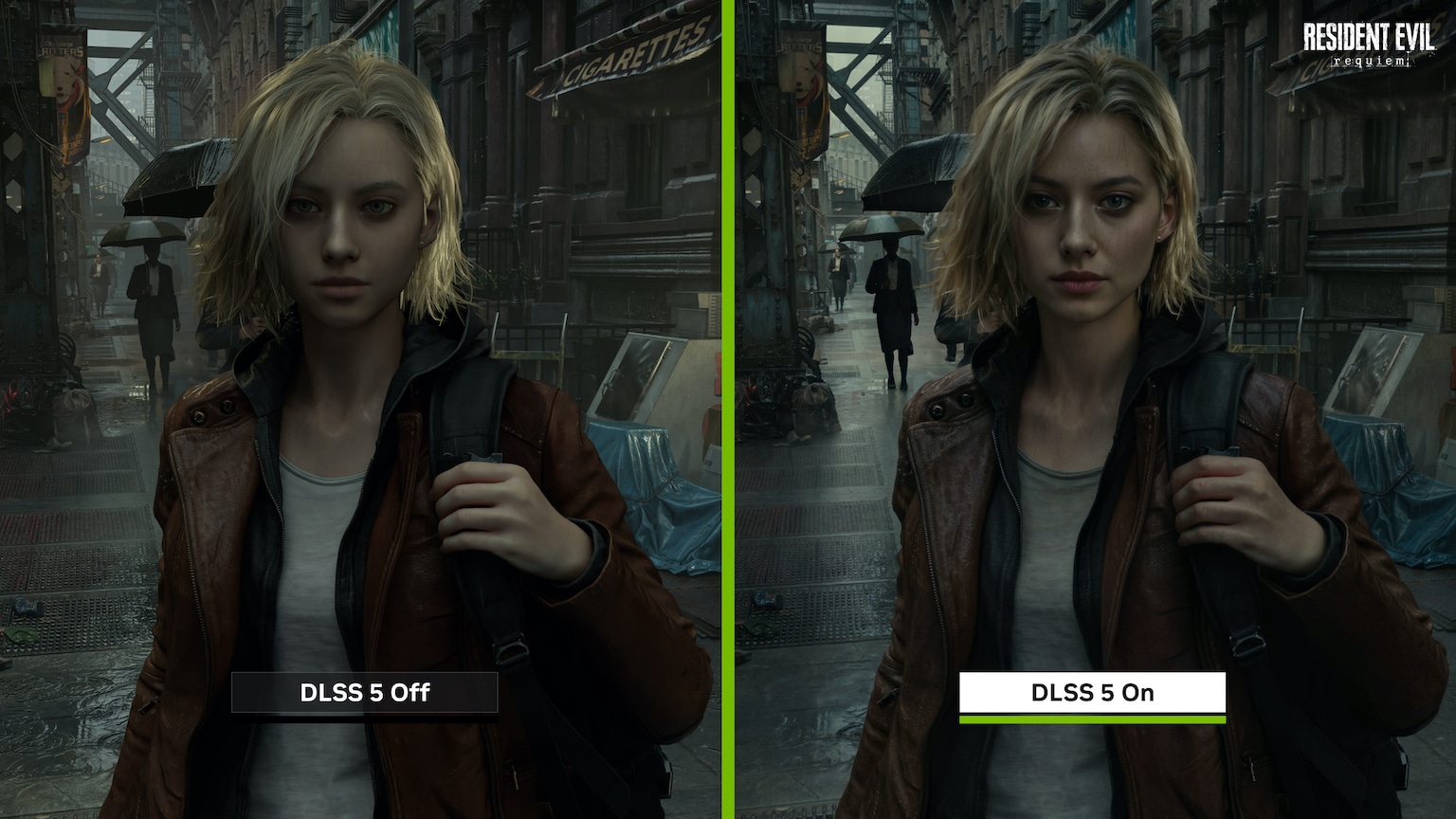
For decades, the gap between how games look and how Hollywood movies look has felt like an immovable wall. Games render each frame in milliseconds. Film VFX studios take minutes, sometimes hours, per frame. No graphics card, however powerful, has been able to close that gap through sheer processing muscle alone. NVIDIA thinks it has finally found a different way through.
DLSS 5, arriving this fall, uses a real-time AI model to inject photoreal lighting and materials directly into a running game frame. It is the most ambitious update to DLSS since the technology launched in 2018, and NVIDIA is calling it the most significant leap in computer graphics since real-time ray tracing first arrived seven years ago.
What DLSS 5 Actually Does
Previous generations of DLSS were fundamentally about performance. The technology upscaled lower-resolution images to look sharper on screen, then evolved further to generate entire frames from scratch in order to push frame rates higher. DLSS 4.5, released earlier this year at CES, extended that approach so aggressively that AI was responsible for generating 23 out of every 24 pixels displayed on screen. That was an impressive engineering achievement, but its primary purpose was still speed.
DLSS 5 changes the goal entirely. Instead of making games run faster, it is designed to make them look fundamentally better, closer to the kind of imagery that has historically required a render farm and a production timeline measured in days rather than milliseconds. The leap is not incremental. NVIDIA is positioning this as a categorical shift in what real-time graphics can achieve, and the technical approach behind it supports that framing.
The system takes each frame’s color data and motion vectors as input, then passes them through a neural model that has been trained to understand the content of what it is looking at. The model recognizes skin, hair, fabric, translucent surfaces, and environmental lighting conditions including front-lit scenes, back-lit scenes, and overcast lighting, all from analyzing a single frame. From that understanding, it reconstructs the image with lighting and material responses that behave the way physics dictates they should in the real world. Subsurface scattering on a character’s skin. The fine sheen of cloth under directional light. The complex way light catches and diffuses through hair. All of it generated in real time, at up to 4K resolution, and kept consistent from one frame to the next so the image never flickers or breaks under motion.
This is a meaningful departure from how real-time graphics have traditionally worked. Historically, developers have had to approximate these kinds of material and lighting effects using carefully crafted shaders and pre-baked data. The results could look impressive, but they were always a calculated imitation of physical reality rather than a simulation of it. DLSS 5 replaces some of that approximation with a model that has learned what photoreal imagery actually looks like and applies that knowledge at runtime.
Why This Generation of Hardware Changes Things
To appreciate why DLSS 5 matters, it helps to understand how far NVIDIA’s graphics architecture has already come and where its limits have historically been.
The story starts in 2001 with the GeForce 3, which introduced programmable shaders and fundamentally changed what game graphics could express. In 2006, CUDA arrived with the GeForce 8800 GTX, opening up the GPU as a general-purpose parallel computing platform. In 2018, real-time ray tracing debuted with the GeForce RTX 2080 Ti, giving developers a way to simulate the physical behavior of light in running games for the first time. Most recently, the GeForce RTX 5090 brought path tracing and neural shaders to consumer hardware in 2025. Across all of those generations, raw compute performance has grown by roughly 375,000 times.
That is an extraordinary figure. And yet despite it, a fundamental constraint has never gone away. A game rendering at 60 frames per second has approximately 16 milliseconds to produce each frame. A single frame of Hollywood-quality visual effects can take anywhere from several minutes to several hours to render on a production system. That gap is not a matter of a few multiples. It is orders of magnitude. No graphics card on the market today, regardless of how powerful, can close it through traditional rendering methods alone.
DLSS 5 does not try to do that. Instead, it uses AI to accomplish in real time what raw rendering power still cannot. Rather than computing every photon bounce or material interaction from scratch, it uses a trained model to infer what a photoreal version of the scene should look like and generate it on the fly. The result is visual quality that gets meaningfully closer to cinematic standards without requiring the computational resources a film studio would use to achieve the same output.
NVIDIA CEO Jensen Huang described the shift as a GPT moment for graphics, a comparison that points to how language models changed what was possible in text by blending rule-based structure with learned generation. DLSS 5 applies a similar principle to images, blending the handcrafted 3D scenes that developers build with AI-generated enhancement to produce something neither approach could achieve on its own.
Built With Creative Control in Mind
One of the practical strengths of DLSS 5 is how much authority it preserves for the developers and artists using it. AI-driven image enhancement carries an inherent risk of homogenizing the look of games, smoothing over the deliberate stylistic choices that give different titles their visual identity. NVIDIA has addressed this directly by giving studios detailed controls over how DLSS 5 is applied.
Developers can adjust intensity levels to determine how aggressively the AI model enhances any given scene. They can apply color grading on top of the AI output to ensure the result fits their game’s established palette. They can also use masking to specify which parts of a scene receive enhancement and which do not, which is particularly useful when a title has specific elements that should retain a particular hand-crafted look. A stylized action game and a realistic survival horror title will have very different ideas about what photoreal means in context, and DLSS 5 is designed to accommodate both.
Integration is built on the same NVIDIA Streamline framework already used by DLSS and NVIDIA Reflex, which means studios with existing familiarity with those technologies can adopt DLSS 5 without rebuilding their rendering pipelines from scratch. For an industry where developer time is always at a premium, that kind of compatibility matters.
The Games Arriving First
The confirmed launch lineup for DLSS 5 spans some of the most anticipated titles in gaming and includes support from several of the industry’s largest publishers, which signals meaningful confidence in the technology from the studios that have seen it in action.
Bethesda is bringing DLSS 5 to Starfield, with studio head and executive producer Todd Howard saying that seeing it run in the game demonstrated how dramatically the technology could bring a world to life. He added that Bethesda has played it and is eager to get it into players’ hands.
CAPCOM is implementing DLSS 5 in Resident Evil Requiem, with executive producer Jun Takeuchi describing it as an important step in pushing visual fidelity forward in ways that help players become more immersed in the world.
Ubisoft’s Vantage Studios is integrating it into Assassin’s Creed Shadows, with co-CEO Charlie Guillemot noting that the way DLSS 5 renders lighting, materials, and characters changes what the studio can deliver to players. He described it as a real step toward making game worlds feel genuinely real.
Beyond those flagship titles, DLSS 5 support is confirmed for Hogwarts Legacy, The Elder Scrolls IV: Oblivion Remastered, Phantom Blade Zero, Delta Force, NARAKA: BLADEPOINT, AION 2, Black State, CINDER CITY, NTE: Neverness to Everness, Sea of Remnants, Where Winds Meet, and more. Publishers backing the technology include Bethesda, CAPCOM, Hotta Studio, NetEase, NCSOFT, S-GAME, Tencent, Ubisoft, and Warner Bros. Games.
The Bigger Picture
DLSS 5 is a signal that the next frontier in graphics is not purely about more powerful hardware. It is about smarter rendering, using AI to fill in what traditional computation cannot achieve within the constraints of real-time performance. That shift has implications that extend well beyond gaming. The same principles enabling photoreal graphics within a 16-millisecond frame could eventually reshape how interactive experiences are built across entertainment, training simulation, architectural visualization, and other fields where real-time realism matters.
There is also a broader story here about where AI fits into creative workflows. DLSS 5 is not replacing artists or overriding their decisions. It is giving them a new tool that operates underneath their work, enhancing what they build without dictating how it looks. That is a more nuanced and ultimately more useful role for AI in creative production than many of the headline applications that have dominated the conversation in recent years.
For now, the most immediate thing to watch is what games actually look like when DLSS 5 ships this fall. The technology is promising on paper and compelling in early demonstrations. Whether it delivers that promise at scale, across a wide range of titles and hardware configurations, is the question the next few months will answer.

