


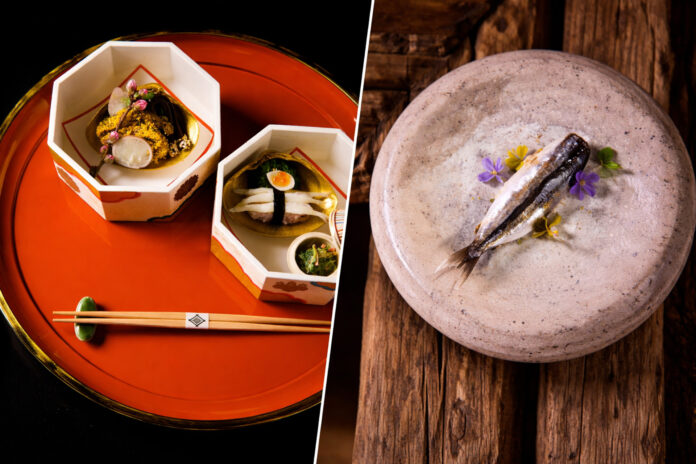

Luxury dining once announced itself loudly. It arrived layered, polished, abundant, eager to impress. Plates carried the weight of global sourcing and technical bravado. Dining rooms hummed with performance. Meals unfolded as events meant to be witnessed as much as tasted.
That language has softened.
Today, the most compelling expressions of luxury are quieter, more deliberate, and far more intimate. In the world’s most thoughtful Michelin-starred restaurants, restraint has emerged not as a rejection of sophistication, but as its most fluent dialect. Fewer ingredients. Composed plates. Flavors that linger rather than dazzle. Luxury now speaks in a lower register, trusting that those who are listening closely will understand.
The Beauty of Exposure
Restraint begins with exposure. When a dish is stripped to its essentials, the ingredient is no longer supported by excess. It stands alone, illuminated. Any flaw is instantly legible. Any success unmistakable.
At Le Bernardin, seafood is treated with a clarity that feels almost moral. A dish of barely cooked scallops arrives warm and pale, their surface just yielding, their centers still translucent. There is no aggressive sear to impose flavor. Instead, the scallop’s sweetness is allowed to emerge gradually, clean and marine.
Roasted bone marrow is present, but sparingly. It dissolves into the scallop rather than asserting itself, offering depth without heaviness. Baby turnips, tender and faintly bitter, provide contrast not through drama but through restraint. Even the sauce behaves with discretion, brushed on, never pooled. The result is a dish that feels balanced rather than constructed. You taste not technique, but judgment.
This is restraint as confidence. The kitchen knows that what it has sourced is enough.
Fire as Editor
In the Basque hills, restraint takes on a more elemental form.
At Etxebarri, the menu reads almost ascetically, yet each dish feels profoundly considered. Everything passes over fire, but fire here is not spectacle. It is a tool for refinement, an editor rather than an amplifier.
An egg yolk with white truffle arrives without adornment. The yolk is gently warmed, its surface intact, the interior flowing slowly when pierced. The truffle’s aroma lifts upward, carried by heat rather than fat. There is no garnish to interrupt the moment. You are asked to sit with it, to notice texture, temperature, and scent as they evolve in real time.
The famed aged beef chop follows the same logic. Grilled, rested, sliced. No sauce. No distraction. The beef tastes of smoke, iron, and time. Its luxury lies not in embellishment but in restraint so complete that nothing interferes with the animal’s story.
Even dessert resists indulgence. Milk ice cream paired with beetroot reduction tastes almost austere at first, then quietly generous. The dairy is pure and cold, the beetroot earthy and mineral. Together, they form a conversation rather than a climax. It is a dessert that asks for attention, not applause.
Precision Compressed Into a Single Bite
Nowhere is restraint more concentrated than in Edomae sushi, where the entire philosophy of luxury can be distilled into one mouthful.
A piece of katsuo, lightly smoked over straw, appears almost plain. The magic is aromatic rather than visual. Smoke arrives first, fleeting and delicate, then recedes to reveal the fish’s depth. The rice beneath is warm, gently seasoned, pressed just enough to hold, loose enough to dissolve on the tongue. Wasabi is present as a whisper, disappearing before it can assert itself.
Nothing here seeks to surprise. The pleasure comes from balance so exact it feels inevitable. Restraint, in this context, is compression. Dozens of decisions are folded into a single, precise gesture.
Restraint as Architecture
In Kyoto, restraint becomes spatial, temporal, and emotional.
At Kikunoi Honten, a kaiseki meal unfolds slowly, with an attention to rhythm that feels almost musical. Courses are not designed to impress individually, but to resonate collectively.
A seasonal vegetable dish might feature a single ingredient, simmered gently in a clear broth. The seasoning is so restrained that it barely announces itself. Instead, it frames the vegetable, allowing its texture and natural sweetness to emerge. The bowl itself, chosen with care, holds as much meaning as the food it contains.
Sashimi arrives thickly sliced, arranged with space between each piece. That negative space matters. It slows the eye and invites reflection. Garnishes exist only to support flavor, never to decorate. Even luxury ingredients, such as matsutake mushrooms, are treated with humility. Steamed rather than seared, they release aroma softly, filling the room rather than the plate.
Here, restraint is not minimalism. It is discipline shaped by centuries of refinement.
Why This Language Resonates Now
Restraint speaks to a cultural moment that values discernment over display. In a world saturated with stimulation, subtlety feels radical. The absence of excess becomes a form of generosity.
These meals do not rush. They do not overwhelm. They ask the diner to slow down, to notice, to feel. Luxury emerges not from abundance, but from clarity. Not from being impressed, but from being moved.
There is also a quiet ethics embedded in restraint. Local sourcing, seasonality, and respect for ingredients are expressed without proclamation. Sustainability is not announced. It is felt in the calm logic of the menu.
The Quiet Authority of Saying Less
Restraint is not a trend. It is a recalibration of values.
The most compelling luxury dining experiences today are those that trust their audience. They assume curiosity, sensitivity, and taste. They do not explain themselves loudly. They offer a mood, a moment, a memory that resists easy translation.
The calm plate.
The exposed ingredient.
The measured pace.
These are not signs of scarcity. They are signs of assurance. In the evolving language of luxury dining, restraint has become the clearest expression of confidence, a way of saying that nothing more is needed.