


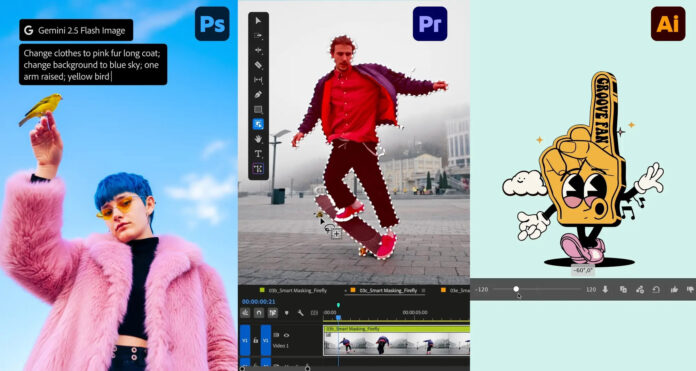

If creativity had a pulse, it just spiked.
At Adobe MAX 2025, the company turned up the volume on what it means to be “creative” in the age of intelligent machines. Gone are the days when generative AI was a novelty for prompt-happy hobbyists. Adobe has made it the heartbeat of Creative Cloud, embedding agentic AI into the same tools that built modern visual culture: Photoshop, Illustrator, Premiere Pro, Lightroom, and Express.
This year’s MAX felt less like a software update and more like a statement of intent. Adobe isn’t chasing AI trends—it’s reshaping the creative process itself.
The New Co-Pilot: Creativity Meets Conversation
Imagine telling Photoshop what you want, and it just… gets it.
Adobe’s new AI Assistant, debuting in Photoshop on the web, is powered by what the company calls agentic AI—a system that understands creative context, not just commands. You can type “make this portrait warmer,” and the assistant knows whether you mean lighting, tone, or vibe. It even offers tutorials and alternative approaches, the way a seasoned art director might.
Adobe isn’t stopping there. The same conversational assistant is rolling out in Firefly and Adobe Express, transforming how creators interact with software. This is less about replacing skill and more about offloading the busywork—so professionals can stay focused on the story, the layout, the feeling.
Photoshop Gets Brains, Not Just Brawn
Photoshop’s upgrades this year read like a creative wish list. The beloved Generative Fill tool now partners with models from Google’s Gemini 2.5 Flash Image, Black Forest Labs FLUX.1 Kontext, and Adobe’s own Firefly Image Model 5. The result: edits that feel cohesive, not conjured.
Need to upscale a grainy crop? Generative Upscale, powered by Topaz Labs, can boost resolution to 4K with startling realism. For compositors, Harmonize automatically adjusts lighting and color when you drop a person or object into a new scene. It’s like having a digital lighting crew on call.
These tools don’t just save time—they reshape what’s possible under a deadline. But they also raise a question: when software makes “good enough” this easy, what happens to the thrill of creative struggle?
Premiere Pro: Editing Without the Grind
Over in video land, Premiere Pro gets its own injection of AI muscle. AI Object Mask, now in public beta, can track people or objects automatically. No more hours of rotoscoping frame by frame. Rectangle, Ellipse, and Pen Masking add geometric precision, while the new Fast Vector Mask accelerates tracking even in 3D space.
Combined with Generative Extend, which intelligently fills or stretches clips to fit your timeline, the update makes professional-grade editing as fast as storytelling itself. For overworked editors, it’s liberation. For purists, it’s another reminder that craft and automation are now sharing the same suite.
Lightroom and Illustrator Find Their Flow
Lightroom’s Assisted Culling uses machine learning to scan your entire shoot and flag the sharpest, best-lit, or most expressive images. You can tweak what “best” means—focus, pose, emotion—and it learns over time.
Illustrator, meanwhile, is getting smarter and faster. Generative Text-to-Vector tools allow artists to create icons or shapes from prompts, while gradient and snapping improvements polish the details. Saving files is now up to six times faster, which feels minor until you’re 50 artboards deep at 2 a.m.
Adobe’s message here is clear: AI isn’t just about creation; it’s about flow. Every second saved is a second reclaimed for creativity.
Firefly: The Engine of Imagination
Behind all this is Firefly, Adobe’s expanding generative AI ecosystem. This year’s star is Firefly Image Model 5, capable of native 4-megapixel renders with stunning anatomical and lighting accuracy. It powers the new Prompt-to-Edit feature—type what you want changed, and Firefly rewrites the pixels without breaking the mood.
But the real innovation is Firefly Custom Models. In private beta, this lets creators train their own AI models with a handful of reference images to match their signature look. Want every output to carry your color palette, composition style, or logo aesthetic? Just feed it your work. Adobe promises the models are private by default, giving artists the benefits of machine learning without surrendering creative ownership.
Then there’s Firefly Boards, a collaborative space for teams to brainstorm, generate, and export assets together. It now supports Rotate Object (to view AI-generated images in 3D), Preset Styles, and even PDF export for easy sharing. And for bulk production, Firefly Creative Production can apply edits—color grading, background swaps, cropping—to thousands of images at once. It’s Photoshop, but industrial scale.
A World of Models, One Workflow
Adobe also opened the doors to external AI models, integrating names like Topaz, ElevenLabs, Google, OpenAI, Pika, Luma, and Runway directly into Creative Cloud. Creators can choose the right brain for the right job—voiceovers from ElevenLabs, ultra-detail upscaling from Topaz, photorealism from Gemini.
The beauty of this approach lies in flexibility. You don’t have to juggle tabs and APIs; the best models come to you, inside the apps you already know.
100 Innovations and Counting
Adobe claims over 100 new upgrades in this Creative Cloud cycle, touching everything from rendering performance to collaboration features. Most are available today, with some in public beta.
Photoshop’s Generative Fill, Upscale, and Harmonize are live now. Premiere’s AI masking and Lightroom’s Assisted Culling are open for beta testing. Firefly Image Model 5 and Prompt-to-Edit are ready for use, while Firefly Custom Models and Creative Production are invite-only for early adopters.
The Culture of Creation
It’s easy to get swept up in the spectacle—AI that paints, edits, scores, and animates on command. But Adobe’s challenge is cultural as much as technical. In a world flooded with generative content, the value of creativity may shift from production to taste. Knowing what to make might matter more than making it.
Still, there’s no denying the energy of this moment. MAX 2025 didn’t feel like an algorithmic takeover. It felt like a renaissance—a reminder that creativity evolves, and technology, at its best, evolves with it.
As Adobe CEO Shantanu Narayen put it, “We’re not just building tools for creators. We’re building partners.”
And if these partners can think, listen, and learn like humans? The creative frontier just got a lot more interesting.